Pellets for Cooking
What Are Cooking Pellets?
Cooking pellets are small, compact cylinders of fuel made by compressing dry organic waste. They are usually very small and uniform in size, similar to animal feed pellets, which makes them burn cleanly and consistently.
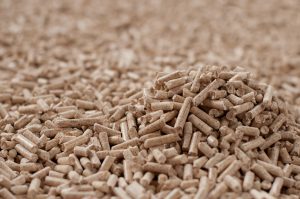
What are Pellets made from?
Typical materials used for pellets include:
- Crop residues such as maize cobs, rice husks, coffee husks, sunflower husks and dry grasses;
- Sawdust and wood waste from carpentry shops and forest logging operations;
- Bagasse (sugarcane residue);
- Other dry organic waste.
How Are Pellets Made?
Pellets are produced using a pellet mill. The process is:
- Drying the biomass until very low moisture. A moisture content below 10% is preferred;
- Grinding the material into fine powder (optional);
- Compressing it under high pressure using a pellet press;
- Cooling and packaging for storage and sale.
What Does a Quality Pellet Look Like?
A good pellet should be:
- Smooth and shiny on the surface;
- Hard, not crumbly when squeezed;
- Same size throughout (uniform diameter);
- Dry with no mold or smell;
- No dust forming on the body of the pellet.
Poor quality pellets
- Break easily;
- Produce more smoke and;
- Clog feeders in pellet stoves.
How are pellets stoves different from charcoal and firewood stoves?
Pellet stoves are specifically designed to burn pellets efficiently. They differ from charcoal or firewood stoves because:
| Pellet Stove | Charcoal/Wood Stove |
| Burns very cleanly & efficiently | Produces more smoke/soot |
| Uses pellets only | Uses many fuel types |
| Often has a controlled air system | Has open air, less control |
| Very low ash | More ash and soot |
| Can include automatic fuel feed | Manual fuel addition |
Briquettes for Cooking
What are briquettes?
Briquettes are compressed blocks of cooking fuel made from organic waste. They are bigger than pellets and can be round, square, pillow-shaped, or cylindrical.
Components of a briquette
A good briquette usually contains four key components:
a. Fuel Component (Carbon or Biomass)
This is the main ingredient of the briquette, the part that actually burns and produces energy.
For carbonized briquettes, the fuel component includes:
- Charcoal dust
- Carbonized sawdust
- Carbonized crop residues
- Coconut shell charcoal
- Any biomass that has been turned into charcoal
For non-carbonized briquettes, the fuel component includes:
- Sawdust
- Maize cobs
- Rice husks
- Banana peels
- Market waste
- Grass and agricultural residues
b. Binder (The “Glue”)
A binder helps the briquette hold together, especially after drying. Some feedstock have natural binders (like lignin), but many need an extra binding material.
The binder makes briquettes firm and stable; reduce crumbling and dust; and ensure the briquette burns evenly.
Common binders include:
- Starch (cassava flour, maize flour)
- Molasses from sugarcane
- Clay (used in some traditional charcoal briquettes)
- Paper pulp
- Sweet potato leaves
- Gum arabic
c. Additives (Optional Improvements)
Additives are materials added in small amounts to improve performance, such as burn efficiency, ignition, or emission control.
Examples of additives include:
- Lime (calcium oxide): reduces smoke and improves burning for raw biomass briquettes
- Bentonite: used with clay to strengthen charcoal briquettes
- Borax: helps release briquettes easily from molds (industry use)
- Waste paper: helps ignition and reduces dust
- Sawdust / rice husk mix: improves air flow during burning
d. Moisture (Water)
Water is added during production to help bind the ingredients and shape the briquette. Water helps mix materials evenly, activates starch binders and helps form a uniform, well-shaped briquette.
Types of briquettes
Briquettes can be categorized into two namely:
- Non-carbonized briquettes
- Carbonized briquettes
What are Non-carbonized briquettes?
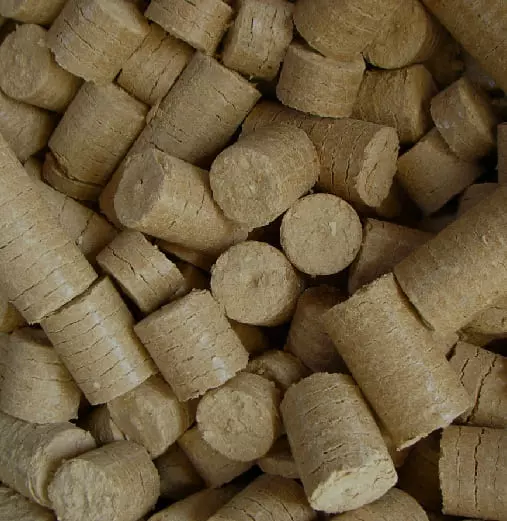
Non-carbonized briquettes are made by compressing raw biomass directly, without carbonizing it. They are usually light brown or grey in colour.
What are Non-carbonized briquettes made from?
These briquettes can be produced from:
- Crop residues (maize cobs, husks, stalks);
- Sawdust and wood shavings;
- Grass and leaves;
- Market waste (peelings, vegetable waste);
- Other biodegradable waste.
How are Non-carbonized briquettes made?
- Collect and sort dry biomass
- Grind it into smaller particles
- Mix with a binder and water
- Press into briquettes using a manual or motorized briquette press
- Dry the briquettes in the sun or a dryer
What does a good non-carbonized briquette look like?
- Uniform shape
- Dry and firm
- Light brown or grey colour
- Does not crumble easily
- Has little dust
- Burns steadily with a yellow flame
Advantages
- Uses waste biomass directly, hence requires less treatment
- Lower production cost than carbonized briquettes
- Good for areas with plenty of agricultural waste
- Reduces pressure on forests
- Burns longer than plain firewood
- Ideal for institutional stoves, boilers, and gasifier stoves
6. Disadvantages
- Produces more smoke than carbonized briquettes
- Absorbs moisture easily, hence are difficult to store
- Needs stoves designed to handle raw biomass
Carbonized Briquettes
What are carbonized briquettes?
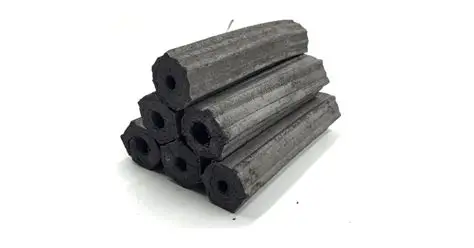
Carbonized briquettes are made by first converting biomass/ fuel component into charcoal, and then compressing the charcoal into briquettes. They are black, smooth, and dense.
What are carbonized briquettes made from?
They can be made from:
- Charcoal dust
- Carbonized sawdust
- Carbonized agricultural waste
- Coconut shells
- Any biomass that can be charred
How are they made?
- Dry biomass is burned in a low-oxygen environment to produce charcoal, a process called carbonization.
- Charcoal is crushed into fine powder, known as charcoal dust.
- Charcoal is mixed with water and a binder.
- The mixture is pressed into briquettes using a briquette machine.
- The briquette is then dried before packaging.
What does a good carbonized briquette look like?
- Deep black colour
- Smooth and firm
- Does not crack when pressed
- Very little dust
- Burns with a steady red glow
- Does not produce much smoke
Advantages of using a carbonized briquette
- It burns cleaner and hotter than non-carbonized briquettes
- It produces very little smoke
- It is a great substitute for wood charcoal
- It has a high energy density
- It is ideal for both households and restaurants
6. Disadvantages
- Requires carbonization, which adds cost
- Needs careful control to avoid inefficient charcoal production
- Not suitable for all types of stoves