LPG (Liquefied Petroleum Gas) is a clean-burning cooking fuel that comes in gas cylinders. It burns with a clean blue flame and produces very little smoke. This makes it healthier, faster, and more efficient than charcoal or firewood.
What LPG is made of
LPG is mainly a mixture of:
- Propane and Butane
These gases are compressed into liquid form so that they can be safely stored in a cylinder.
Where LPG comes from
LPG is produced during:
- Petroleum refining, when crude oil is processed in refineries.
- Natural gas extraction, where LPG is separated from natural gas at gas processing plants.
LPG Cylinder Sizes in the Ugandan Market
| Cylinder Size | Best For |
| 3 kg | Small households, students, occasional cooking |
| 6 kg | Small to medium households |
| 12 kg | All household sizes |
| 12.5 kg | All household sizes |
| 13 kg | All household sizes |
| 35 kg | Restaurants, schools, institutions |
| 45 kg | Restaurants, schools, institutions |
Parts of a Household LPG System
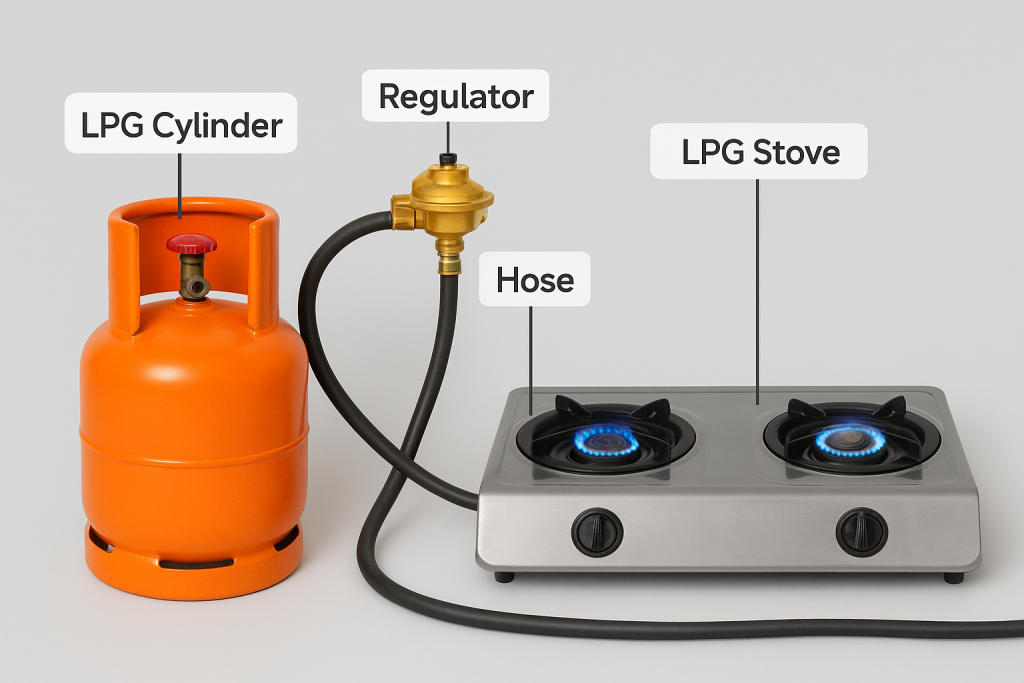
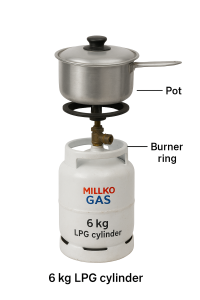
The 3kg and 6kg systems have fewer components than the rest of the systems. This is because the cooking is done at the cylinder top. For the bigger sizes, a complete LPG cooking setup normally includes:
a. LPG Cylinder
Stores the gas in liquid form. Comes in various sizes.
b. Regulator
It controls the pressure of the gas leaving the cylinder and has two common types i.e. clip-on regulator which simply clips onto the cylinder valve (common for household) and a screw-type regulator which tightens using a spanner.
c. Hose Pipe
Carries gas from the cylinder to the cooker. It is usually rubber or reinforced PVC, with a recommended life span of 2–5 years.
d. Hose Clips / Clamps
These secure the hose to the regulator and stove, preventing leaks.
e. LPG Cooker / Stove
Where the gas burns. Cookers can be 1-burner, 2-burner, 3-burner or full cookers with an oven. For the 3kg and 6kg cylinders, the banner is only one (1).
Types of LPG Cooking Systems
A. Self-Igniting Systems
These systems light automatically when you turn the knob.
The features of this system include
- Built-in spark (piezo ignition)
- No matchbox required
- Found in many tabletop stoves and modern gas cookers
How to Use
- Turn the gas knob ON
- Press/turn until you hear a click
- Flame appears automatically
B. Assisted-Ignition Systems
These systems require you to provide a flame.
Features
- Use a matchstick or lighter
- Common in basic 1-burner or 2-burner stoves
How to Use
- Light the match or lighter
- Turn the burner knob ON
- Bring the flame close to the burner
- The gas catches and produces a blue flame
NB: The match or lighter has to be ignited before the knob is turned on.
How to Operate an LPG System (Step-by-Step)
A. Connecting the Cylinder
- Place the cylinder on a flat surface
- Ensure the cylinder valve is OFF
- Connect the regulator
- Attach the hose from the regulator to the stove
- Tighten hose clips
B. Lighting the Stove
- For self-igniting → just turn the knob
- For assisted ignition → light a match then turn knob on
C. Turning Off
- First turn the burner knob to OFF, then close the cylinder valve → self-ignition.
- Turn of the burner knob and ensure the flame is gone out and no gas is being produced anymore → assisted ignition.
D. Checking for Leaks
Use the soap test:
- Mix water + soap
- Rub around the regulator and hose connections or cylinder in case u suspect it is leaking.
- If bubbles appear on the regulator and hose connections, turn off cylinder and fix immediately.
- If bubbles appear on the cylinder, return it to the supplier immediately.
Why LPG is Good for Cooking
- It burns cleanly with no smoke.
- It cooks fast compared to charcoal.
- It saves time due to instant heat provision.
- It reduces indoor air pollution.
- It is portable and therefore easy to use in rural or urban homes.
- LPG is efficient, as one cylinder can last weeks, depending on use
- LPG is safe when used correctly
Safety Tips (Important for All Users)
- Always cook in a well-ventilated space.
- Keep the cylinder upright, both during use and transportation.
- Do not store the cylinder near fire or heat.
- Replace worn-out hoses.
- Close the cylinder valve after cooking.
- Do not use a leaking cylinder — call your LPG supplier.