Biogas is a mixture of gases, mostly methane (CH₄) and carbon dioxide (CO₂) produced by the digestion of organic materials in oxygen constrained conditions. This process is called Anaerobic Digestion (AD).
What is biogas made from?
Biogas is made from a mixture of water and organic waste, which is commonly known as “feedstock.”
Organic waste can be obtained from the following sources:
- Animal manure from cattle, goats, pigs and poultry;
- Crop residues including maize cobs, banana stems, rice husks.
- Kitchen waste from leftover foods in households and restaurants.
- Market waste such as rotting foodstuffs, food husks and peelings, and others.
- Sewage and human waste from sewage and faecal sludge treatment and containment facilities.
- Industrial organic effluent from dairy processing facilities, breweries, sugar processing industries and agro-processing industries.
What is the process of biogas production?
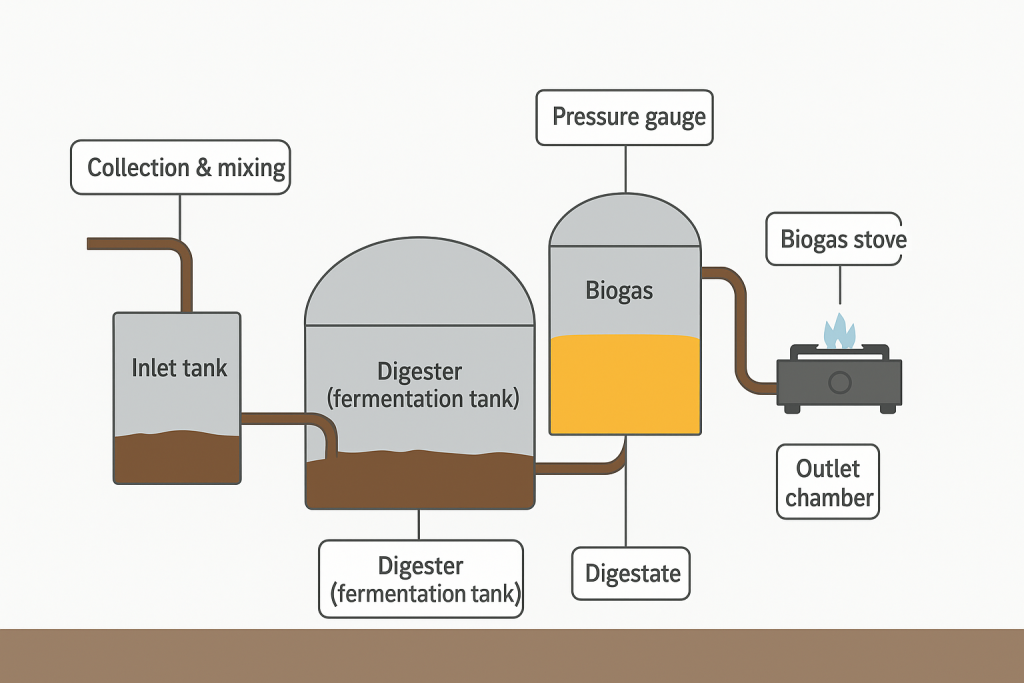
- Collection & mixing: Organic Waste is collected and mixed with water to make a porridge like mixture and poured into an inlet tank. Some feedstock instantly forms the porridge like mixture i.e. animal dung, while solid waste requires soaking in water for a period of 12 – 24 hours.
- Anaerobic digestion: The mixture proceeds to a sealed digester (fermentation tank), usually by gravitational flow. In the sealed digester, microbes break down the organic matter in the absence of oxygen. The breakdown has four (4) progressive stages i.e. hydrolysis → acidogenesis → acetogenesis → methanogenesis.
- Collecting the biogas: The biogas progressively accumulates above the mixture in the digester as breakdown progresses. Then, the gas is either piped to a gas storage tank or used directly by piping to a kitchen or bulb.
- Utilisation: Biogas is cleaned/conditioned as needed and used for cooking, heating, lighting or to generate electricity (via a gas engine/CHP).
- Digestate management: After biogas has been extracted from the mixture, there is a left over solid/liquid, called digestate. This digestate is piped out of the system through gravitational flow. After removal of the biogas, the mixture is converted to a stable digestate and can be used directly as organic fertiliser.
How does one optimize biogas production from different feedstock?
1) Animal Manure (Cattle, Goats, Pigs, Poultry)
Challenge: Some manures (especially poultry and pig waste) have high nitrogen, causing excess ammonia. Excess ammonia slows down the biogas production process and affects the quality and quantity of biogas produced.
Optimization Practices:
- Mix poultry and pig manure with waste that is rich in carbon so as reduce the production of ammonia. Carbon rich feedstock includes cow dung, crop residues, kitchen waste, sawdust and dry leaves.
- Dilute with water to reduce ammonia concentration, particularly for poultry droppings.
- Pre-treat with anaerobic storage/composting for 1–2 weeks to reduce pathogens and stabilize organic matter.
- Maintain appropriate moisture, especially for drier manure (goat dung), by mixing with wetter feedstock.
2) Crop Residues (Maize cobs, Banana stems, Rice husks)
Challenge: These contain too much lignocellulose. The excessive lignocellulose makes it hard the waste to be degraded.
Optimization Practices:
- Size reduction: The residues are chopped, shredded, hammered to increase their surface area. Size reduction could be coupled with the following practices:
- Biological pre-treatment: by soaking in enzymes like cattle urine to break the fibers.
- Combine with nitrogen-rich wastes such as poultry waste, piggery waste.
Challenge: Rice husks should not be used in excess. Excessive use rice husks cause accumulation of silica.
Optimization practices:
- Always mix the rice husks with wet organic waste.
Why biogas?
Energy & household benefits
- Provides a clean cooking fuel that reduces indoor air pollution and associated health risks from traditional biomass stoves.
- Can be used for cooking, lighting, and electricity generation (through biogas-fired generators), increasing household energy access and resilience.
Agricultural co-benefits
- Digestate from anaerobic digestion is a nutrient-rich organic fertiliser that can improve soil fertility and crop yields, supporting smallholder agriculture and reducing reliance on chemical fertilisers.
Waste management & environmental benefits
- Converts organic waste (animal manure, food waste, crop residues, sewage) into usable energy, reducing open dumping, uncontrolled decomposition, and related greenhouse gas emissions.
- Properly managed systems reduce odour and pathogen loads compared with unmanaged manure piles.
Economic & social benefits
- Saves household time (less fuel collection) and money (reduced fuel purchases).
- Creates local jobs in construction, operation and maintenance of biogas systems and in supply chains for biogas services.
Uganda’s biogas potential — short facts and implications
- The Uganda National Livestock Census 2021 found that roughly 6.8 million households kept at least one type of livestock (about 72.8% of households), indicating a very large distributed source of animal manure that could be harnessed for biogas. This livestock ownership provides strong feedstock potential for household and community biogas systems across the country.
Safety & operation notes
- Biogas is flammable: installations must follow safe design, ventilation, proper piping, and include safety valves and flash arrestors.
- Systems require regular feeding and operator training to get consistent results.
BOQS For fixed Dome Systems
| Quantity | ||||||
| ITEM | 4M3 | 6M3 | 9M3 | 13M3 | 20M3 | |
| 1.0 General Bulk Materials | ||||||
| 1.1 (a) sand (plaster) | 1 truck (Elf) | 1 truck (Elf) | 1 truck (Elf) | 1 truck (Elf) | 1 truck(forward) | |
| (b) sand (Building) | 1 truck (Elf) | 1 truck (Elf) | 1 truck (Elf) | 1 truck (Elf) | 1 truck(forward) | |
| 1.2 Gravel ¼* | 5w/b | 6w/b | 10w/b | 1 truck (Elf) | 1 truck (Elf) | |
| 1.3 cement | 10bags | 14 bags | 17 bags | 22bags | 40 bags | |
| 1.4 Bricks | 800 pieces | 100pieces | 1200 pieces | 2000pieces | 3500pieces | |
| 1.5 Acrylic emulsion paint | 3litres | 4litres | 5litres | 6litres | 10 liters | |
| 1.6 Welded/square mesh | 1piece | 1piece | 1piece | 1piece | 3pieces | |
| 1.7Twisted bar (Y-12) | 1piece | 1piece | 1piece | 2pieces | 4pieces | |
| 1.8 PVC piece 4”,20feet (medium) | 1piece | 1piece | 1piece | 1piece | 1piece | |
| 1.9PCV Pipe½ (varies with distance) | 1piece | 2 pieces | 3pieces | 3pieces | 5pieces | |
| 1.10Water drainage value (varies with distance) | 2 pieces | 2 pieces | 2 pieces | 2 pieces | 2 pieces | |
| 1.11 fitting material and sundry | Lumpsum | Lumpsum | Lumpsum | Lumpsum | Lumpsum | |
| 1.12 Ring wire (8mm) | 1piece | 1piece | 1piece | 1piece | 2 pieces | |
| 1,13 transport for bricks and cement | Lumpsum | Lumpsum | Lumpsum | Lumpsum | Lumpsum | |
| 1.14 waterproof cement | 4kg | 6kg | 6kg | 10kg | 20kg | |
| Sub-TOTAL | ||||||
| 2.0 Biogas Materials &excavation | ||||||
| 2.1 Dome gas pipe + valve | 1piece | 1piece | 1piece | 1piece | 1piece | |
| 2.2Biogas stove +nozzle and horse pipe | 1piece | 1piece | 2pieces | 2pieces | 3pieces | |
| 2.3Pressure gauge with accessories | 1piece | 1piece | 1piece | 1piece | 1piece | |
| 2.4 Biogas filter | 1piece | 1piece | 1piece | 1piece | 1piece | |
| 2.5 Excavation costs | Lumpsum | Lumpsum | Lumpsum | Lumpsum | Lumpsum | |
| Sub-total | ||||||
| 3.0 Company Service fees | ||||||
| 3.1 Accommodation | To be provided by the biodigester owner | |||||
| 3.2 Meals for masons | To be provided by the biodigester owner | |||||
| 3.3 Quality control | To be provided by the biodigester company | |||||
| 3.4 Helpers/porters | To be provided by the biodigester owner | |||||
| 3.5 Annual maintenance fee (once a year) | To be provided by the biodigester company | |||||
| Sub-total | ||||||
| 4.0 Bio-digester commissioning | ||||||
| 4.1 cow dung | 1000 | 2,200 | 3,500 | 5,000 | 10,000 | |
| 4.2 water | 1000 | 2,200 | 3,500 | 5,000 | 10,000 | |
| 4.3 Labor for initial feeding | ||||||
| Sub-total | ||||||
| 5.0 Other Information | ||||||
| 5.1 Hours for cooking per unit size | 2 | 3 | 5 | 6.5 | 12 | |
| 5.2 Quantity of dung / animal waste | 30kgs or 1.5 basins | 60kgs or 3 basins | 120kgs or 6basins | 160kgs or 8basins | 300kgs or 15basins | |
| TOLL FREE TEL +256 800 399 236 | ||||||